
Team Training That Works: How Investing in People Improves Retention in Hospitality
Hospitality staff training and development, as well as retention, are constant challenges in the hospitality industry. As discussed in our previous blog on work-life balance, creating a supportive environment for your team is key to keeping them engaged. But there’s more to it. Training and development also play crucial roles in restaurant employee satisfaction and retention. A strategy focused on continuous learning can lead to long-term commitment, benefiting both employees and your business.
Recruitment and training: A strong link
Today, employees want to work in places where they see potential for growth. This means creating opportunities for development from day one. Recruiting means more than filling a role in your company. It means finding a team member who will match your team and is motivated to be a part of it, staying in their position and growing together with your business.
A 2021 global survey revealed that 76% of Gen Z respondents believed learning is key to career success, compared to lower percentages in older generations. This shows the importance of offering development opportunities across all levels of your workforce. Recruitment strategies should focus on presenting opportunities for growth. Learning and development play an essential role in attracting top talent.
When hiring, consider candidates who are not only skilled in hospitality but who are eager to learn. Offer them pathways to develop both in their current roles and beyond. Training doesn’t always need to focus on core hospitality tasks. Offering diverse skills like photography or digital marketing can keep employees engaged, and these skills can also benefit your business. For instance, an employee trained in digital marketing could boost your social media presence.
The importance of continuous training
Training budgets are an investment in your team’s growth. According to Statista, the global workplace training industry is expected to reach almost $401 billion in 2024. Training is increasingly seen as a critical factor in boosting talent progression and employee retention. In the U.S. alone, companies spent over $100 billion on workplace training in 2022.
Employees who feel supported in their professional development are more likely to stay long-term. Opportunities for continuous learning show that you value their progress, not just as workers, but as professionals. Even if in the long run these skills might take them beyond their current roles (e.g. they decide to change their profession, open their own business, etc.), the benefits for your company can be significant. And the probability of them actually staying in your company is quite high. Improving staff retention in hospitality often comes down to showing people you’re invested in their future.
Investing in training also strengthens your team’s ability to adapt. As hospitality evolves with new technologies and consumer demands, a well-trained team is more agile, and able to meet challenges head-on.

Coaching for leadership and growth
Personalised coaching is another powerful tool for developing your team, especially those in leadership roles. At Gezelle, we work with Flor de Maria Paredes Mattos, a professional management coach, who offers expertise in head chef coaching programs and coaching other senior staff. Investing in coaching for key team members can lead to better team dynamics, more confident leaders, and improved overall performance in your business.
Leadership coaching is particularly impactful in hospitality, where strong leaders are essential for maintaining team morale and productivity. Coaching can provide the guidance senior staff need to manage their teams effectively, helping them to foster a positive workplace culture and ensure they are building a good team.
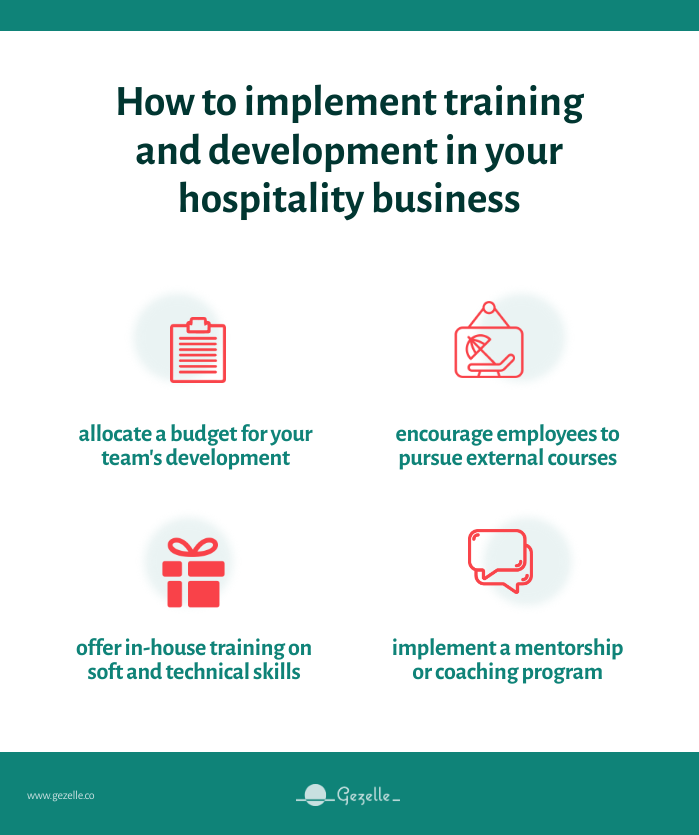
How to implement training and development in your hospitality business
Allocate a specific budget for your team’s development. This shows a clear commitment to employee growth.
Encourage employees to pursue external courses that interest them, even if these courses aren’t directly related to hospitality. Consider sponsoring them at least partially.
Offer in-house training on soft and technical skills. For example, leadership skills, customer service techniques, or new kitchen technologies.
Implement a mentorship or coaching program, particularly for senior staff. Coaching can help develop their leadership abilities and build a more cohesive team.
By making training a regular part of your business culture, you’re showing your team that you’re invested in their future. And trust us, your investment has a huge chance of paying off.
Long-term benefits
There can be a fear that by offering extensive training, you might “train your employees out of their jobs.” But the reality is that people who feel valued and supported are more loyal. When employees see that they can grow within your business, they’re less likely to leave.
Moreover, investing in employee growth has immediate benefits. A team with expanded skills can contribute in new ways, improving the service your business offers. A better-trained team is also a more motivated team, leading to higher levels of job satisfaction and stronger performance overall.
__
Hospitality recruitment, training, and coaching are essential to building a strong, committed team in hospitality. By investing in your team’s development—both through formal training and personalised coaching—you’re setting the stage for long-term retention, better team morale, and business success.
For guidance on creating a training plan or exploring coaching services for your team, reach out to our team at Gezelle. We’re here to help you find the best ways to invest in your people and build a team that’s ready to grow with your business.