
Designing Better Menus – How Procurement Starts With Purpose
Restaurant menu design is often treated as a creative or culinary task. But in hospitality, it’s one of the most strategic tools you have. A good menu needs to do a lot at once. It has to reflect what guests want, stay aligned with seasonal availability, follow market trends, work within cost constraints, and remain practical to execute. It all about balance. The best menus manage to cater for most guests without compromising on identity or values.
At the same time, a good menu should reflect what the business stands for. That means thinking beyond flavour. In today’s industry, sustainable menu design is part of a wider system that connects procurement, sustainability, ethics, and operational efficiency. What you put on the page is shaped by how and where you source it, and how that fits into a bigger picture of responsible hospitality.
Consumers (including diners) are paying attention. A recent Sodexo study found that 41% of consumers expect restaurants and food outlets to provide clear carbon labeling on menus. Additionally, 36% expressed willingness to pay premium prices for low-carbon meals, provided they receive clear communication about the benefits. Similarly, PwC's 2024 Global Consumer Insights Survey revealed that more than 80% of consumers say they are willing to pay more for sustainable produced or sourced goods. That means a menu can’t just be popular. It has to be considered: built around what’s available, what’s responsible, and what makes long-term sense.

Locally sourced ingredients cut down your carbon footprint, shorten delivery times, and often arrive fresher. Local sourcing also improves traceability and builds stronger relationships with regional suppliers. The Sustainable Restaurant Association notes that it’s one of the simplest ways to reduce food miles and add resilience to your supply chain.
Seasonal menu planning matters just as much. Menus that shift with the seasons taste better, rely less on imported and force-grown crops, and cost less to produce. When you use what’s in season, you’re working with nature rather than against it. Tools like Seasonal Food Guide (for US) ot National Trust’s Guide to seasonal food make it easy to stay aligned with what’s naturally available in your region.
A menu also benefits from menu engineering - planning around what’s already easy to come by. Working with suppliers to identify surplus stock or reliable staples can reduce over-ordering, cut waste, and avoid sourcing bottlenecks. Ingredient crossover between dishes helps build stronger, more flexible relationships with producers: ones that adapt and improve over time. Choosing the right suppliers is just the beginning—how those ingredients arrive and are stored matters just as much. Our guide on smart logistics covers everything from bulk storage to delivery optimisation.
Impact should be considered across every product category. Low-impact ingredients and supplies—those that require less water, fuel, or packaging, are better for both the environment and the bottom line. In spa menus, drinks, and cleaning supplies, the same logic applies. Look for goods with Soil Association certification or similar assurances of minimal chemical use and environmental care.
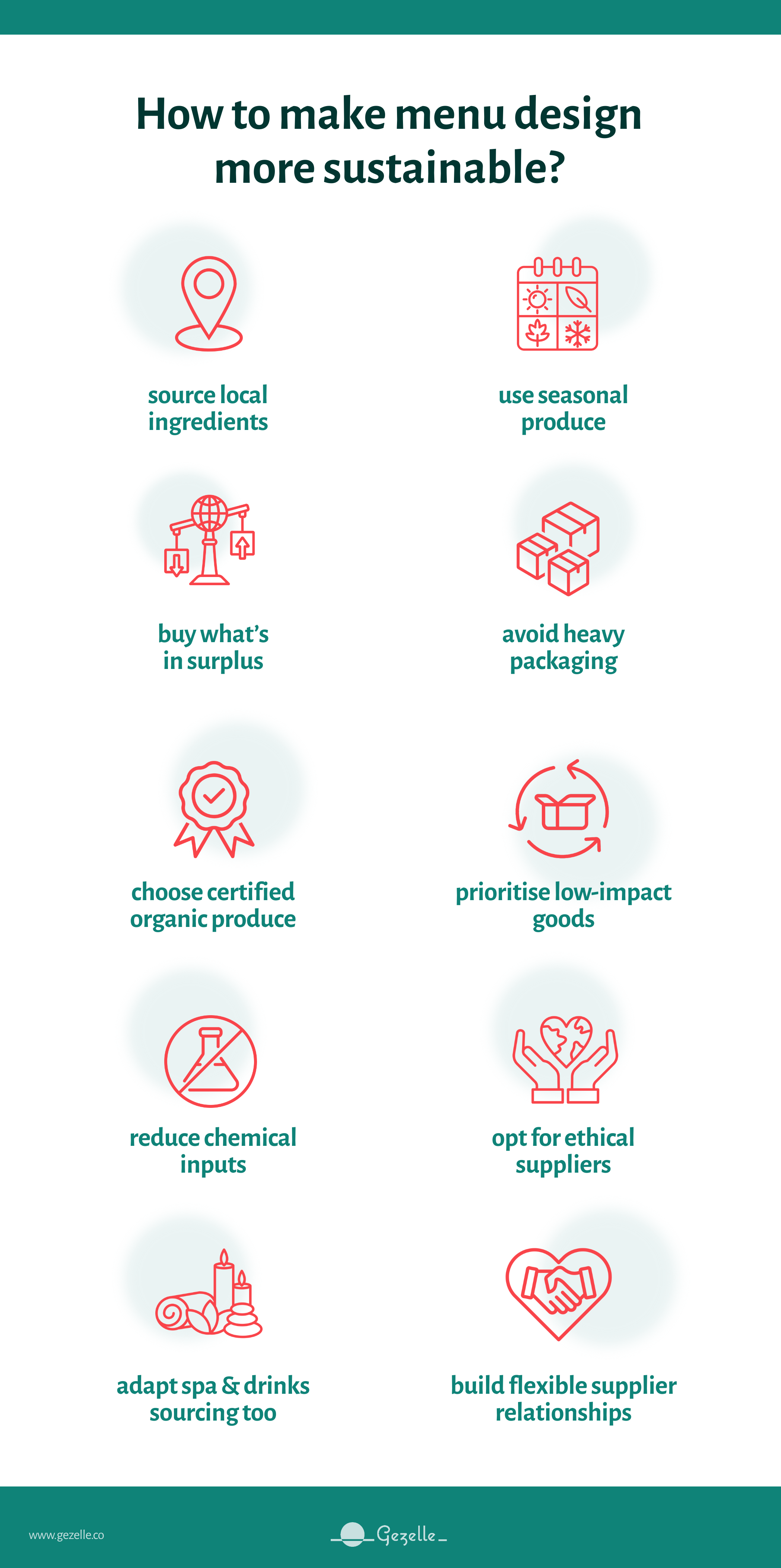
Chemical inputs are another area worth rethinking. Choosing food grown with fewer pesticides, preservatives, or antibiotics not only protects the environment but also aligns with rising consumer demand for healthier, more transparent meals. Organic and low-intervention labels offer a practical benchmark.
Underlying all of this is the need to buy from the right people. Work with suppliers who value ethical labour practices, fair pay, and planet-first production methods. Use tools like Ethical Consumer to vet brands and producers. Ethical sourcing in hospitality should matter just as much as the ingredient itself. For more on building supplier relationships and cutting delivery waste, see our procurement deep-dive.
Designing a menu starts long before the kitchen. It begins with procurement decisions: what to source, who to buy from, and what values to prioritise. When you build around locality, seasonality, simplicity, and ethics, you’re not just creating a better menu. You’re creating a better business. If you need help with sustainable menu design, reach out at hello@gezelle.co.